
Paying off a mortgage at renewal time in Surrey after 65
Yes. If you own your Surrey home and are 55 or older, a reverse mortgage can pay out the mortgage coming up for renewal, so that payment stops. Interest builds on the new loan and your equity goes down. On typical Surrey values the question is how much equity you want to keep. Start this before the renewal date.


You'll speak with a licensed mortgage broker at BRX Mortgage Inc. Or call: 778-561-5837
Who this page is for
You are a Surrey homeowner in your late 60s or early 70s, and a renewal date is on the calendar. The mortgage payment still leaves every month, even though your income is now a pension.
This page is about that renewal moment only. If the home is a newer build in Grandview Heights, that page covers the extra timing questions that come with a younger loan and a more recent purchase.
What happens when the term ends
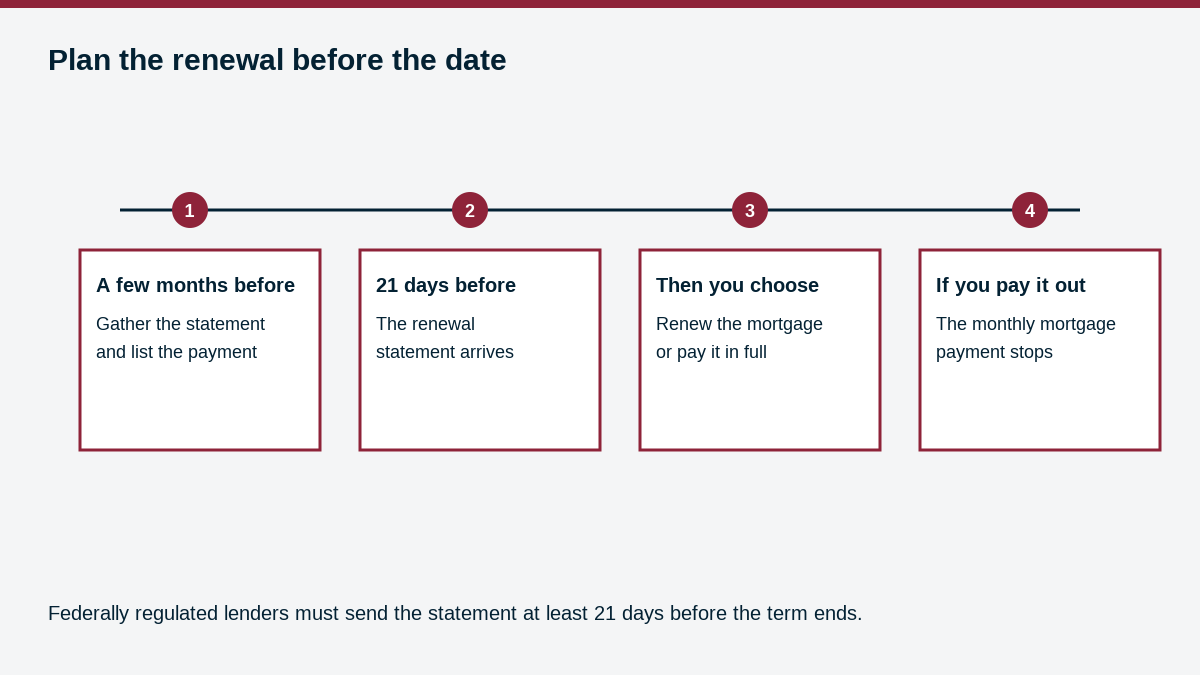
A mortgage term can run from a few months to five years or longer. The Financial Consumer Agency of Canada says you have to renew at the end of each term unless you pay the balance in full. Paying it out is one of the two choices, and a reverse mortgage is one way to do that.
If your contract is with a federally regulated lender, such as a bank, that lender must send a renewal statement at least 21 days before the term ends. The statement shows the remaining balance, the new payment, how often you would pay, the new term and any fees. The same lender must also tell you at least 21 days ahead if it will not renew.
If you take no action, the term may renew on its own, on the conditions in that statement. That is why waiting until after the date is a poor plan.
Why to start a few months early
The review takes time: documents, an appraisal, independent legal advice and, if you go ahead, paying out the old mortgage. Starting a few months before the date leaves room for that work.
It also leaves room to check how the mortgage is registered. FCAC notes that a collateral charge can secure more than the mortgage itself, including a line of credit or a car loan. Ask your lender, lawyer or notary how yours is set up.
If you pay the mortgage out before the term ends, you may face a penalty. Paying it at the end of the term is the clean point FCAC describes.
What the reverse mortgage does with the old loan
The reverse mortgage pays the existing mortgage first. Once that balance is gone, that monthly payment stops. The reverse mortgage itself has no regular payments, but interest builds and equity goes down.
You keep title. You keep paying property taxes, home insurance and upkeep, and the loan can come due if you do not. Any cash left after the payout is yours to use. If a HELOC or other charge sits on title, those are paid out too, which uses part of the amount you qualify for.
Example only: the payment that stops
| Monthly payment | Before (example) | After (example) |
|---|---|---|
| Mortgage | $1,780 | $0 required |
Example only, not a quote, offer or approval. Coverage still depends on the house, your age and the lender. Interest builds on the new balance and your equity goes down.
Surrey values and leftover equity
For 2026, BC Assessment's typical Surrey figures were $1,464,000 for a detached house and $649,000 for a strata home, using values as of July 1, 2025. At those levels, many owners will find the reverse mortgage can cover the remaining mortgage. The live question is how much equity you want to leave in the home for yourself or your estate.
Your own value can differ from these typical figures, and the lender orders its own appraisal.
If you would rather renew or switch
You do not have to use a reverse mortgage. You can renew with your current lender, or you can try to move the mortgage. FCAC says a new lender has to approve you and may use different criteria than the lender you have now. On a pension, that approval can be hard even when the home has substantial equity.
If renewing the same payment still fits your month, that may be the simpler path. We will say so.
Another alternative: property tax deferment
BC's Property Tax Deferment program lets eligible homeowners 55 and older defer property taxes through the Province. The deferred amount is a government loan with interest, and you apply with the Province, not the City of Surrey. It addresses the tax bill, not the mortgage payment that comes due at renewal. See the Government of BC property tax deferment page for current eligibility and how to apply.
Talk it through before you sign
Get independent legal advice before you sign. FCAC notes a lender may require it, and you choose your own BC lawyer or notary. Talk it through with your adult children if you can. The leftover equity is part of what they may inherit. If someone else is on title, they usually have to be a borrower as well and meet the minimum age of 55.
The BC Retirement Cash-Flow Reset
The BC Retirement Cash-Flow Reset: free 14-Day Payment Freedom Review for homeowners 65+. Serving Surrey homeowners, we look at your renewal date, your current payment and what a payout would leave in the home, then put the options side by side so you are not deciding after the letter arrives.
After the quiz you get a personal call within one business day, then a written plan 14 days after your documents arrive. There is no fee for the review. If paying out the mortgage is not the right step, that is what you will be told.
Sources
- Financial Consumer Agency of Canada, Renewing your mortgage
- Financial Consumer Agency of Canada, reverse mortgages
- Government of BC, Property tax deferment program
- BC Assessment, Lower Mainland 2026 property assessments
Keep reading
Questions
Can I use a reverse mortgage to pay off my existing mortgage in Surrey?
Yes, if you are 55 or older and there is enough equity. The reverse mortgage pays that mortgage first, and that monthly payment then stops. Interest builds on the new balance and your equity goes down.
What happens if I do nothing when my term ends?
The term may renew on its own, on the conditions in the renewal statement. Federally regulated lenders must send that statement at least 21 days before the term ends, and must tell you at least 21 days ahead if they will not renew.
Should I wait until after the renewal date to look at a reverse mortgage?
No. The appraisal, legal advice and payout take time, and paying the mortgage out before the term ends can bring a penalty. Starting a few months early is the calmer path.
Will a reverse mortgage cover my balance on a typical Surrey home?
Often the value is high enough that coverage is not the main issue, but it still depends on your home, your age and the lender. Typical 2026 assessed values are $1,464,000 for a detached home and $649,000 for strata. The harder question is how much equity you want to keep.
Do I still pay property taxes after the mortgage is paid out?
Yes. You keep paying property taxes, home insurance and upkeep. The reverse mortgage has no regular payments, but interest builds and equity goes down.
See where your month stands
The quiz takes a couple of minutes. It adds up what you pay each month and shows whether a review makes sense for you.
You'll speak with a licensed mortgage broker at BRX Mortgage Inc. Or call: 778-561-5837